The California Raisin Industry
On approximately 180,000 acres, the 1,500 California Raisin growers produce 100% of the U.S. raisins, totalling approximately 200,000 tons annually in an area within a 60 mile radius of Fresno, California – known as the central San Joaquin Valley.
California Raisins – Farm to Table.
California raisins are proud to say,
“Our ingredients statement say it all – RAISINS!”
Episode 1: A Rich History in the Making
Episode 2: Taking no Chances with Food Safety
Episode 3: Caring for the California Raisin
Episode 4: Growing and Harvesting the California Raisin
Episode 5: The Versatile California Raisin
Episode 6: Buying and Selling the California Raisin
Episode 7: A Nutrient Rich Food for Life
Episode 8: Life of a Raisin Farmer
California Raisins are inspected under the most rigid standards by both plant quality control technicians and USDA inspectors throughout the packaging process, thus assuring that California Raisins are the cleanest, highest quality in the world. After final inspections, raisins are automatically weighed and packed in a variety of bulk industrial and convenient retail sizes. California Raisins are then shipped throughout North America and the world for consumers to enjoy.
Part of the crop is used to make raisin juice concentrate (a minimum of 70 percent natural fruit soluble solids) and raisin paste (made from 100 percent raisins), which are added to a variety of foods, including dairy, confectionery and bakery items.
Raisins in Ancient times
History indicates that raisins were discovered for the first time by accident when they were found in the dried form on vines as early as 2000 BC. Wall paintings from ancient times show that dried fruits were consumed and used as decorations in the Mediterranean regions of Europe. Historians tell us the ancient Phoenicians and Armenians took the first steps in perfecting viticulture, the process of grape growing and selection.
Between 120-900 BC
The Phoenicians started colonial vineyards in the areas of Malaga and Valencia (Spain), and in Corinth (Greece). About this same time, the Armenians founded their vineyards in Persia (Turkey, Iran, Iraq). These bountiful growing areas had the perfect climate for making raisins and were also close to Greece and Rome, the first markets for raisins. Muscat raisins, oversized with seeds and a fruity full flavor, were the primary crop in Malaga and Valencia. Currants, tiny seedless, tangy raisins were planted in Corinth, Greece, where historians believe they got their name.
The Phoenicians and Armenians then began to trade raisins with the Greeks and the Romans who consumed them in large quantities. As the popularity of the raisins grew, so did their value. They were given as prizes in sporting events, used as barter to trade, and used as a cure for what ails you. Ancient physicians prescribed raisins as potions that could cure everything from mushroom poisoning to old age. Emperor Augustus feasted on small birds stuffed with raisins. Even Hannibal had raisins in his troops’ rations when he crossed the Alps.
11th Century
For all their popularity, though, raisins were not exported to the rest of Europe. Shipping methods were too poor to maintain the quality of the raisins for long travel. All of that changed in the 11th century. Knights returning from the crusades brought raisins back to Europe with them. They had sampled the dried fruit during their travels through the Mediterranean and Persia. When the knights went home and began to crave raisins, a huge demand was created. Fortunately, packing and shipping techniques had improved enough for raisins to be sent all over Northern Europe.
14th - 16th Century
By the middle of the 14th century, currants and raisins were an important part of English cuisine. In 1374, prices in England skyrocketed to two pence and three farthings per pounds, which was very expensive at that time.
After a period of time, viticulture spread to France and Germany. Even the English tried to grow currants in the 16th century – but realized their climate was too cold for drying raisins.
Grapes and raisins had become an important part of European cuisine by the time European nations started to colonize the Americas. In Spain, where viticulture had been perfected, grapes were being used to make products such as dry table wine, sweet dessert wines and Muscat raisins. It was only natural that when the conquistadors colonized Mexico, wine and raisins were soon to follow.
18th Century – The Birth of California Raisin Country
Spain’s Queen Isabella sent missionaries to Mexico to teach natives about religion. While they were preaching and teaching, missionaries also passed on their knowledge of viticulture. They used grapes for sacramental wines and also grew Muscat grapes for raisins.
By the 18th century, the Franciscan fathers had settled as far north as present-day Sonoma, California. But, when Spain turned power over to the colonial government of Mexico in 1834, the mission system began its decline. Viticulture – and its strong influence on California agriculture – was one of the mission’s enduring legacies.
1851
A marketable muscat for raisins, the Egyptian Muscat, was grown near San Diego. Since the area didn’t have sufficient water supply, farmers moved to the San Joaquin (wah keen) Valley which has a mild climate and extensive irrigation system perfect for the art of viticulture.
1873
Legend says California’s first raisin crop was grown by nature, not farmers. A massive heat wave hit the valley before harvest, and most of the grapes dried on the vine before farmers could pick them.
1876
English immigrant William Thompson grew a seedless grape variety that was thin-skinned, seedless, sweet and tasty.
Late 1800s
Armenians descended from the first founders of vineyards in Persia began settling in the San Joaquin Valley. The area now supplies raisins for nearly half the world, making it the largest producer anywhere.
Today, of approximately 180,000 acres of raisin grapes are grown in California.
Advertising History of
the California Raisins
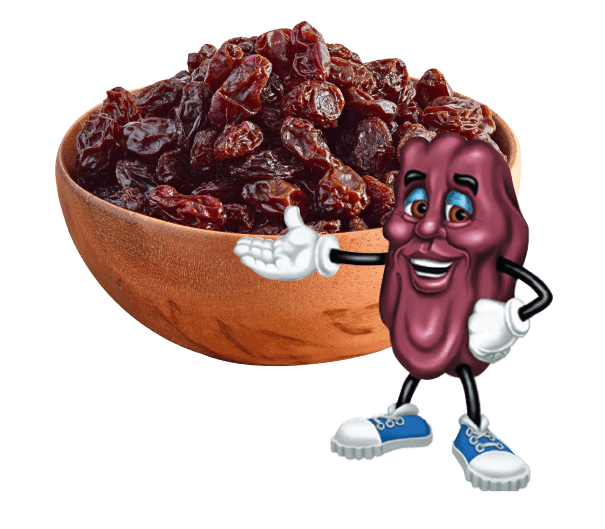
In 1984 the California Dancing Raisin was introduced by the California Raisin Industry marketing staff to increase awareness and demand for California raisins.
Television
- The cost to develop the first animated and tested 30-second commercial was $300,000. It used singer and musician Buddy Miles as the vocalist for the soundtrack “Heard it Through the Grapevine” which was originally recorded by Marvin Gaye.
- The groovy, sunglass-wearing Raisins were clay-animation created by Will Vinton Studios.
- The Raisins starred in an Emmy-nominated 1989 TV special, Meet the Raisins, and had their own Saturday-morning cartoon series on CBS from 1989 – 1990.
- Celebrity Raisins were later introduced with stars such as Ray Charles and Michael Jackson. Jackson’s spot was debuted in 5,700 movie theaters and featured him transforming into a California Dancing Raisin.
Awards
- The Raisins became celebrities overnight when their first commercial, “Late Show”, debuted in 1986 sending them to the top of Adweek’s top ten list.
- In 1986, “Lunch Box” won the Clio Award for best animation. “Late Show” received the Lion D’Argent Award at the Cannes International Film Festival. “Raisin Ray” garnered the Gold Award, Best Animated TV Commercial at the Houston International Film Festival and “Michael Raisin” won a Gold Medal at the International Film & TV Festival of New York.
Contests
Three California Dancing Raisins were officially named. The winning entries were Ben Indasun, Justin X. Grape and Tiny Goodbite. The contest generated over 310,000 entries.
Memorabilia
Demand for memorabilia began within a year after the start of the California Dancing Raisin advertising campaign and peaked during 1988 and 1989. During that time, memorabilia of every type and style using the Dancing Raisins was licensed.
Retirement
The original California Dancing Raisins were retired in 1994.
New Raisin on the Block
- In February 2000, the California Raisin Marketing Board introduced its new fun-loving, health-conscious California Dancing Raisin Character at media events in New York and Los Angeles. The character was received with an overwhelmingly positive response and fond memories.
- Since 2000, the California Dancing Raisins have appeared with Olympic gymnasts at elementary schools across the country, assisted the Fresno Grizzlies Baseball team with special appearances and traveled nationally to cities from Los Angeles to Washington DC to promote raisins as a healthful ingredient.
- In 2001, the California Dancing Raisin rocked its way into national school Foodservice with healthful single serve snack-packs.
- The California Raisins have danced for Presidents, and with Mayors and Governors. They’ve even pumped up Arnold Schwarzenegger.
- In 2000, the California Raisin Board helped position raisins as a versatile and flavorful ingredient in cooking with the “Look Who’s Cooking with California Raisins” chef advertising campaign.
- The most recent advertising campaign to launch in 2004 has the California Raisins spreading the word about the effectiveness of California Raisins in sustaining a healthy lifestyle with the “Look Who’s Training with California Raisins” athlete advertising campaign.